

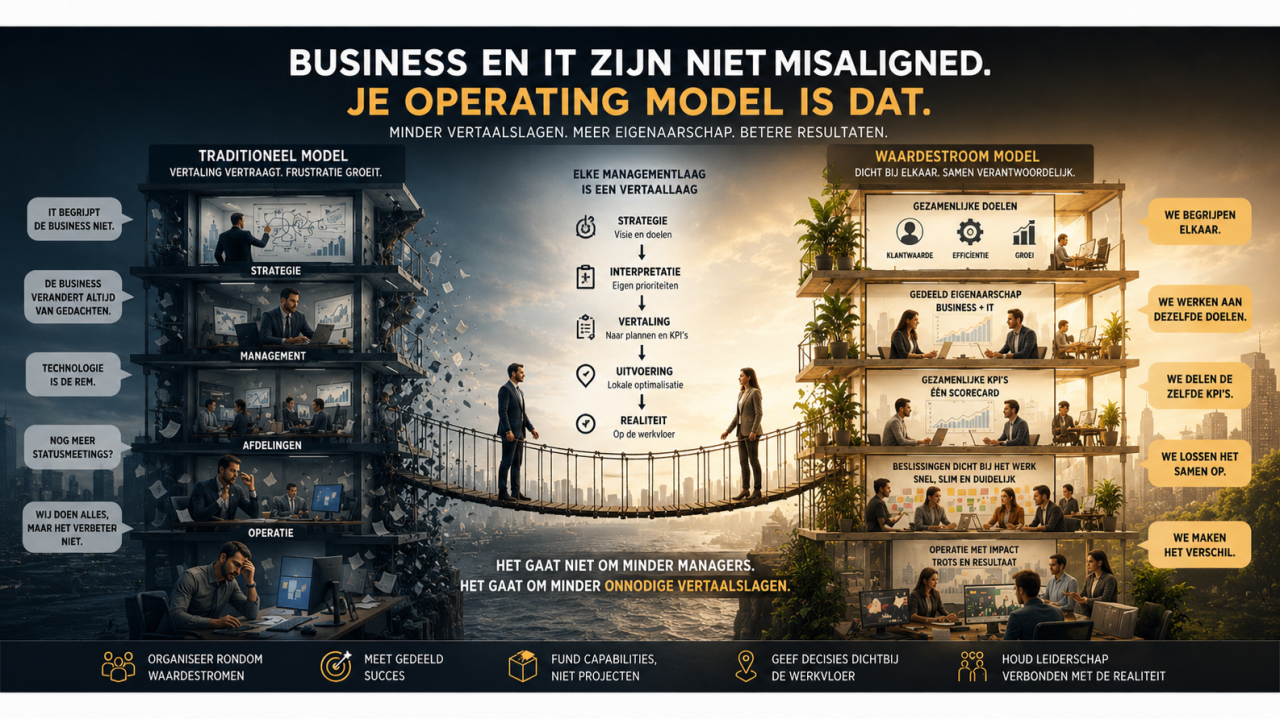
We’ve been talking about Business-IT Alignment for years. As if it’s something you achieve by sitting down together more often.
Another steering committee. Another meeting. Another roadmap session. Another workshop to bring the business and IT “closer together.”
Yet you hear the same complaints in almost every organization.
- “IT doesn’t understand the business.”
- “The business keeps changing its mind.”
- “IT is behind again.”
Increasingly, I wonder whether we’re trying to solve the wrong problem.
In my experience, the business and IT aren’t always as poorly aligned as we think. In fact, I often see leadership teams that know exactly where the organization needs to go. IT generally understands which technology that requires. And the people on the front line know the day-to-day bottlenecks better than anyone.
Yet execution gets stuck.
Not because people don’t understand one another, but because something changes along the way.
More and more, I find that every management layer is effectively a translation layer.
That may sound negative, but I don’t mean it that way. Management is necessary. It provides direction, sets priorities, and develops people. But each layer also unconsciously adds its own interpretation.
- Strategy moves downward.
- Operational reality moves upward.
- And something gets lost at every step.
An executive team might say: “We want a new customer to be fully operational within one day.”
- A few management layers later, that becomes: “Project Phoenix must go live before Q4.”
- It sounds like the same thing, but it isn’t.
- The original goal was a better customer experience.
- Along the way, it turned into a project schedule.
- Exactly the same thing happens in reverse.
An employee says he spends twenty minutes every day on manual tasks because systems don’t connect properly.
- A manager translates that into “process inefficiencies.”
- One level higher, it becomes “no critical issues.”
- Eventually, a green box appears on a dashboard.
- Nobody lied.
- Nobody had bad intentions.
The operating model simply smoothed off the sharp edges.
That’s why I understand the appeal of flat organizations. Fewer management layers often mean fewer translations. Fewer filters. Less distance between the person experiencing a problem and the person who can do something about it.
But a flat organization isn’t a goal in itself.
I’ve seen organizations with barely any management where ultimately nobody dared to make decisions. Everyone had a say, but ownership was completely absent. Every decision became a consensus process.
On the other hand, I’ve seen organizations with several management layers that were surprisingly effective. Not because they were less bureaucratic, but because it was absolutely clear who was responsible for what.
That’s the real lesson, as far as I’m concerned.
It isn’t about having as few managers as possible.
It’s about having as few unnecessary translations as possible.
The shorter the distance between the person experiencing everyday reality and the person authorized to change it, the less likely strategy is to become distorted along the way.
Perhaps that’s also why we so often talk about a gap between the business and IT.
In reality, that gap often lies elsewhere.
Not between the business and IT.
But between strategy, tactics, and operations.
That’s where different KPIs emerge. Where local optimizations are devised. Where attention shifts from customer value to project schedules, from business outcomes to departmental outcomes.
Before you know it, every department neatly meets its own targets while the organization as a whole barely moves forward.
You won’t solve that with yet another alignment session.
You solve it by looking differently at your operating model.
By organizing teams around value streams rather than departments. By agreeing on shared KPIs rather than departmental targets. By placing ownership with the people close to the process. And perhaps most importantly, by regularly getting back into operations yourself as a manager.
- Not to check up on people.
- But to see again where the real work happens.
- Because the biggest problems rarely appear on a dashboard.
You find them in Excel lists nobody wanted to create. In employees repeating the same workaround every day. In processes originally intended to be temporary that have been the standard for years.
That’s often where the truth lies.
Perhaps we should stop asking how to make the business and IT collaborate better.
Perhaps we should ask ourselves a much more fundamental question.
Is our operating model actually designed to make collaboration natural?
Or have we become dependent on coincidentally good relationships between individuals?
Because if collaboration only works because the right people happen to get along…
…then you don’t have a good operating model.
You’re just lucky.
Originally published on LinkedIn. View all blog posts.