

For years we have been told to do more with less. That slogan has quietly turned knowledge work into one of the biggest burnout generators in the modern economy. Every efficiency program, every restructuring, every transformation has pushed people harder while giving them less time, less space and less meaning.
Now AI arrives, and instead of breaking that cycle, many companies are using it to accelerate it.
That is not innovation. That is exhaustion with a shiny new label.
AI was never meant to be the next tool for squeezing workers. It was meant to unlock abundance. It was meant to take the repetitive, draining work off our plates so people could finally focus on the things only people can do: creating, imagining, building, connecting and solving problems that matter.
But we are not heading toward abundance. We are heading toward a world where the gains of AI flow upward, while the losses fall on the people who actually create value.
And here is the part nobody wants to say out loud:
We tax workers for contributing to society, while corporations are rewarded for eliminating their work.
If a person works a full week, they pay income tax, social security, pension contributions and VAT on everything they buy. If a company replaces that person with AI, it pays nothing extra. The productivity gain goes straight to margins and shareholder pockets.
Meanwhile the worker loses income. The government loses tax revenue. Demand shrinks. And the same companies that cut jobs suddenly wonder why their customers cannot afford their products anymore.
This is not a future of work problem. This is a future of society problem.
AI exposes something we have ignored for too long. We have built an economy full of intermediaries and service layers that extract value without adding any. Think of the placement firms that take a percentage of someone’s income forever simply because they made an introduction once. Think of the friction-based business models that rely on customers not paying attention, who unwillingly keep their subscriptions alive.
AI will wipe out many of these middle layers, and that is fine. They were never the value creators.
But if we keep taxing labor while letting extraction layers and corporations keep the gains, we are taxing the wrong part of the system. We are punishing the people who create value and rewarding the systems that remove them.
The future of work should be simple. People do the creative, relational and strategic work that makes companies human. AI handles the repetitive work that burns people out. Productivity gains flow back into society so people can live, spend and keep value-creating companies alive. Taxation shifts from labor to capital so abundance benefits everyone, not just the top of the pyramid.
AI can create a world of abundance. But only if we stop using it to shrink the workforce and start using it to expand what people are capable of.
The real question is not how many jobs AI will replace. The real question is what kind of society we want to build with the time and freedom AI can give us.
What Work Can Become
If we take AI seriously as a tool for abundance, then the future of work becomes much more interesting than the tired efficiency story we have been fed for decades. Work can become something people choose because it gives them meaning, not because it is the only way to survive. Companies can become places where people solve real problems instead of drowning in reporting, meetings and administrative noise. Productivity can become something that lifts society, not something that drains people.
This is not a fantasy. It is a design choice.
We already know what happens when companies use technology only to cut costs. We get burnout, shrinking demand, disengaged employees and a race to the bottom. We have been living in that world for years. AI simply accelerates the consequences.
But we also know what happens when companies use technology to expand what people can do. We get new industries, new jobs, new forms of creativity and new value that did not exist before. Every major technological shift in history has created more opportunity than it destroyed, but only when leaders chose to build, not strip.
The question is which path we choose now.
What Companies Need To Rethink
Companies that want to survive the next decade need to rethink three things.
- How they define value. If value is only measured in quarterly margins, then AI will be used to cut. If value is measured in long-term capability, creativity and customer trust, then AI becomes a multiplier instead of a weapon.
- How they treat people. The roles worth protecting are not the ones AI cannot do yet. They are the ones that guide, govern and improve what AI does. These people will be the backbone of every successful company. Losing them now is a strategic mistake.
- How they contribute to society. If companies automate work, then they must also accept responsibility for the economic impact. That means contributing through taxation, reinvestment and fair distribution of productivity gains. A healthy society is not a cost. It is the customer base that keeps companies alive.
With great power, comes great responsibility. This is not about charity. It is about survival of society.
What Governments Need To Rethink
Governments cannot keep taxing labor as if labor is the only source of value. If AI takes over large parts of the economy, then the tax base must shift toward capital, automation gains and corporate profits. Otherwise the system collapses under its own contradictions.
A society where people have no income, no security and no spending power cannot sustain businesses. A society where companies contribute fairly can.
This is not even close to ideology, it is simply basic economic logic.
What People Should Expect From The Future
People should expect a future where work becomes more human, not less. A future where creativity, empathy, judgment and problem-solving matter more than ever. A future where AI handles the tasks that drain us, so we can focus on the tasks that energize us.
People should expect companies to reinvest the gains of AI into better jobs, better tools, better training and better lives. People should expect governments to modernize tax systems so that abundance benefits everyone. People should expect leaders to stop hiding behind efficiency and start building something worth being part of.
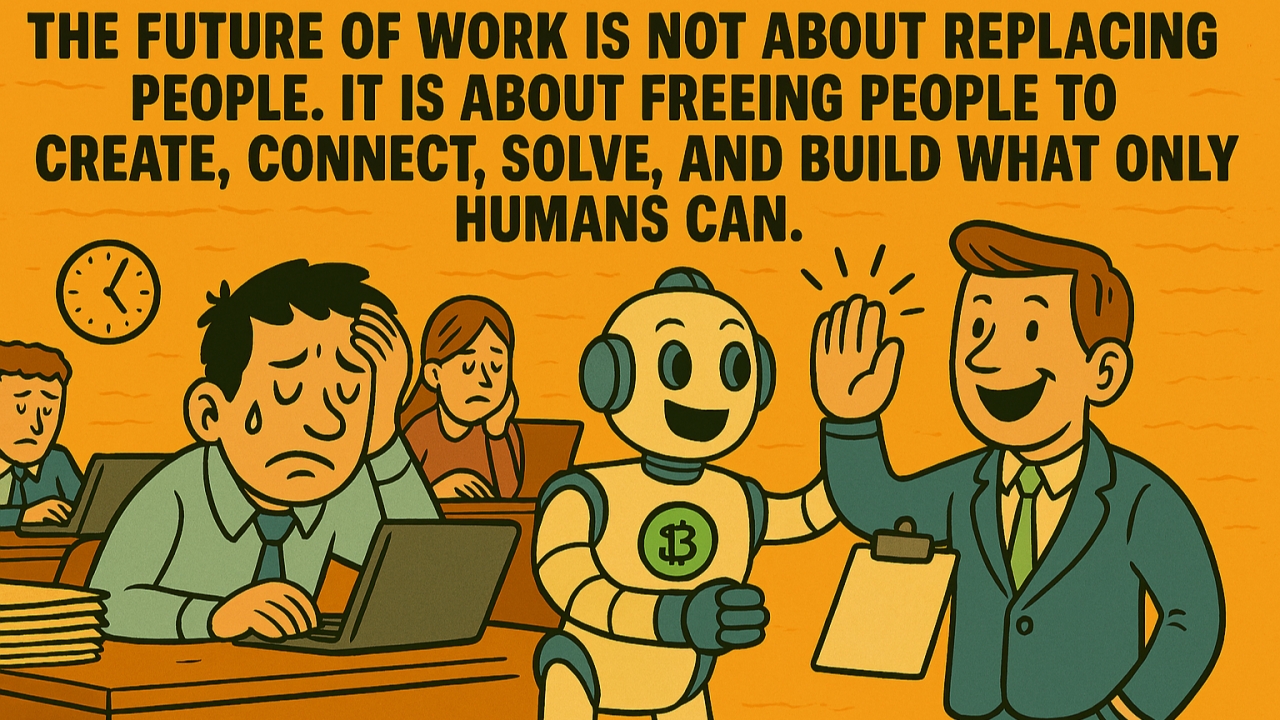
The future of work is not about replacing people. It is about freeing people to create, connect, solve, and build what only humans can. AI should clear the path—not take it away.
A Call To Build Something Better
We are standing at a fork in the road. One path leads to a smaller world where technology is used to cut, squeeze and extract until there is nothing left to take. The other path leads to a larger world where technology expands what people can do and lifts the entire system with it. The first path is familiar. It is the path we have been on for years. The second path requires courage, imagination and a different understanding of value.
The future of work will not be decided by algorithms. It will be decided by the choices we make now. Companies can choose to reinvest the gains of AI into people, capability and long-term strength. Governments can choose to modernize tax systems so that prosperity is shared and sustainable. Workers can choose to demand a future where technology serves them instead of replacing them.
None of this happens by accident. It happens when leaders stop treating people as a cost and start treating them as the foundation of every meaningful achievement. It happens when we stop chasing efficiency for its own sake and start building systems that make life better, not harder. It happens when we stop asking how little we can get away with and start asking how much value we can create together.
AI gives us the tools to build a society where work is more human, companies are more resilient and prosperity is more widely shared. The question is not whether that future is possible. It is whether we are willing to choose it.
The time to choose is now.
Originally published on LinkedIn. View all blog posts.