

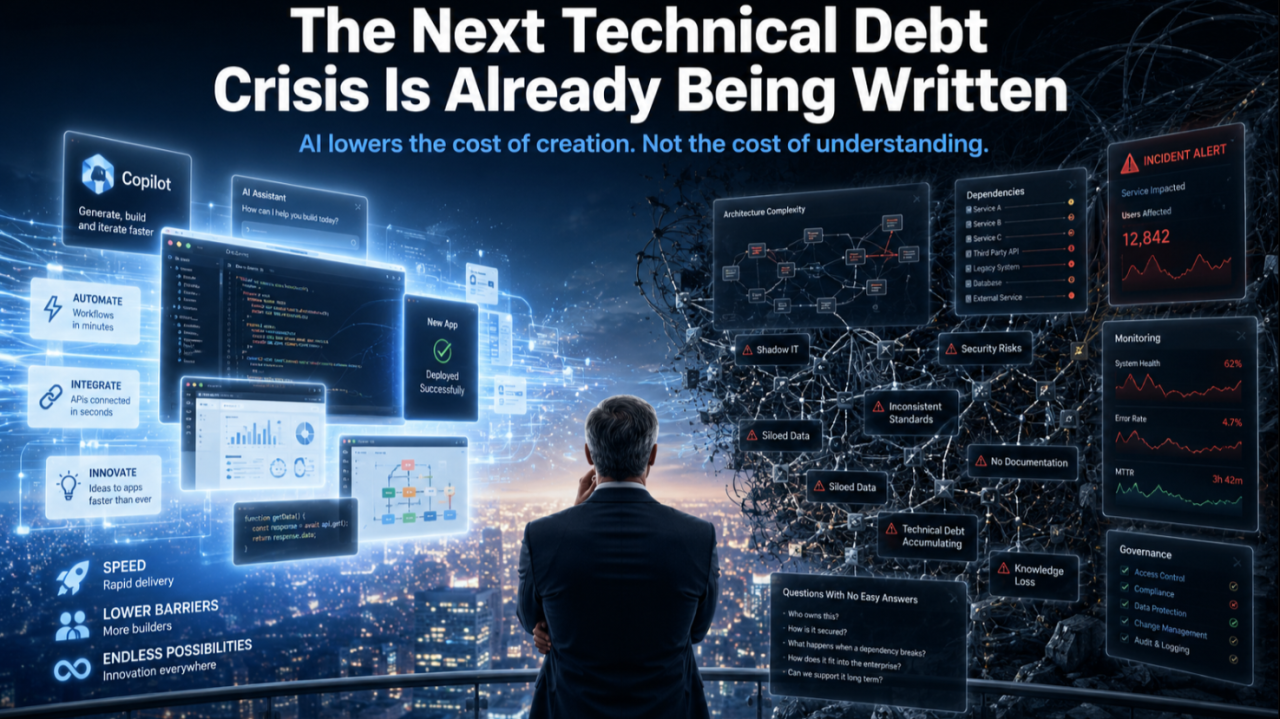
The Next Technical Debt Crisis Is Already Being Written
A while ago I wrote about the dirty work of IT. The work nobody celebrates. The projects nobody puts on LinkedIn. The endless cycle of cleaning up technical debt, fixing broken processes, standardizing environments, documenting systems nobody fully understands anymore, and keeping critical services running while everyone else focuses on the next shiny initiative.
At the time, I argued that much of IT’s real value is created after the excitement fades. I still believe that. And I think we’re about to learn that lesson all over again, this time with AI.
Let me be clear. I am not anti-AI. Far from it. I use AI almost daily and genuinely believe it will become one of the most transformative technologies of our generation. But every major technology shift creates new challenges alongside new opportunities.
AI has dramatically lowered the barrier to creating software, automations, workflows and integrations. People can now build in days what previously required weeks. Business users are creating applications. Citizen developers are creating automations. Teams are connecting systems that previously required specialist knowledge.
On the surface, this looks fantastic. And often it is. Until someone has to maintain it.
That is the part many organizations are missing. AI has reduced the cost of creating technology. It has not reduced the cost of understanding technology. It has not reduced the cost of governing technology. It has not reduced the cost of securing technology. And it certainly has not reduced the cost of operating technology at scale.
The result is predictable. We are creating more technology than ever before, while investing proportionally less time in understanding how it all fits together. That gap eventually becomes technical debt.
Most AI-generated solutions do not fail because the code is obviously terrible. In fact, much of it looks surprisingly good. Functions are neatly structured. Comments are well written. The application works. The demo impresses.
The issue appears one layer higher. Who owns it? How is it monitored? How is access controlled? What happens when a key API changes? Where are the backups? How is disaster recovery tested? Who understands the data flows? How does it fit into the wider architecture?
These are not coding problems. They are systems thinking problems. And systems thinking remains one of the most valuable skills in IT.
This is not the first time technology became easier to produce. We saw similar cycles with outsourcing. We saw it with low-code platforms. We saw it with cloud adoption. We saw it with SaaS proliferation.
Every time the cost of creation drops, organizations create more things. Far more things. Eventually, the operational complexity catches up. Then suddenly everyone starts talking about governance, standardization, architecture and resilience. Not because those topics became fashionable, but because reality arrived.
I suspect the next major shortage in IT will not be people capable of generating code. AI is already helping solve that problem. The shortage will be people capable of understanding complex systems.
People who can see dependencies before they become outages. People who understand security beyond a compliance checklist. People who can distinguish between a clever proof of concept and a sustainable production platform. People who know how technology, processes and people interact.
In other words, the people who clean up the mess.
The organizations that benefit most from AI will not necessarily be the ones producing the most AI-generated output. They will be the organizations that can absorb it responsibly. The ones that combine innovation with governance, speed with architecture, and experimentation with accountability.
Because AI can help us type faster. It can help us build faster. It can help us automate faster. But somebody still needs to understand what is being built.
History suggests that when we skip that step, the bill does not disappear. It simply arrives later. Usually in IT. Usually during an outage. Usually at the least convenient moment possible.
The dirty work is not going away. If anything, it may become more important.
As AI accelerates the creation of technology, the value of understanding technology increases. Not understanding a single application, but understanding the ecosystem. Understanding the consequences. Understanding the trade-offs. Understanding where complexity hides before it becomes tomorrow’s incident.
That has always been the dirty work of IT. And judging by what we are seeing today, demand for that skill is about to increase rather than disappear.
#AI #TechnicalDebt #ITLeadership #EnterpriseArchitecture #DigitalTransformation #OperationalResilience #Governance #CIO #CTO #SystemsThinking #ShadowIT #AIGovernance #TechnologyStrategy #Innovation #ITTransformation
Originally published on LinkedIn. View all blog posts.