

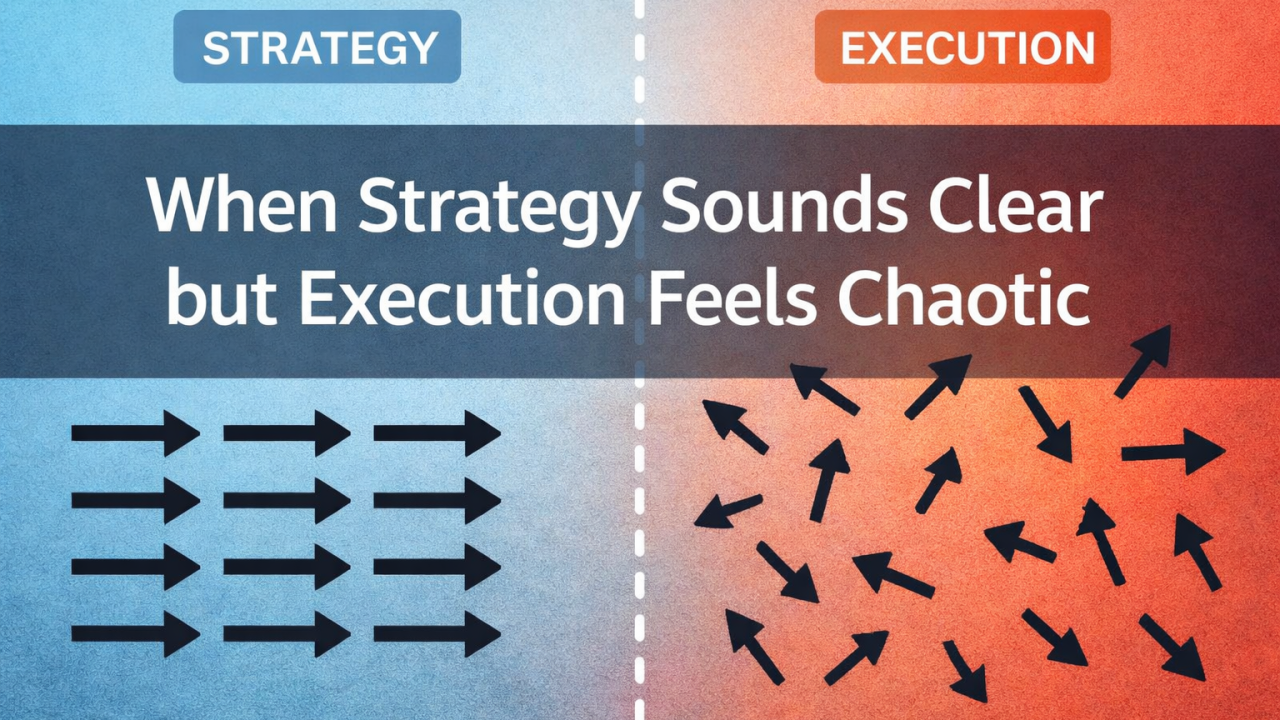
The CEO thinks it’s going well.
But somewhere in the organization, people are quietly drowning. In the boardroom, the story sounds coherent. The strategy is clear. The priorities are aligned. The transformation is “on track”. Dashboards are green. Steering decks are crisp. Updates end with “no major risks”.
And yet—walk one floor down, or join a delivery call, and you feel it immediately.
The hesitation before people speak. The careful wording. The unspoken question: “Which priority are we following this week?”. Because on the ground, the experience is different:
Work doesn’t flow. It collides.
Teams wait on decisions that never quite arrive. Dependencies multiply. People solve the same problem three times in three different ways—because nobody is empowered to settle it once.
Everyone is busy. Very little actually lands. This is not failure by incompetence. It’s failure by misalignment.
How the gap quietly forms
Most CEOs don’t ignore execution. They genuinely believe the direction is understood. They’ve explained it. They’ve repeated it. They’ve put it on slides.
What they underestimate is what happens between intent and action.
In large organizations, layers exist for a reason—but over time, they start protecting each other. Middle management doesn’t lie. They translate:
They soften messages. They shield teams from pressure. They shield leaders from noise.
And slowly, the truth gets polished away. Not because anyone is malicious— but because surfacing chaos feels risky. So instead of saying “this doesn’t work”, people say:
- “We’re making progress”
- “There are some challenges”
- “We’re aligning offline”
Until misalignment becomes normal.
When leaders step in the wrong way
Eventually, something breaks. Deadlines slip. Costs rise. Trust erodes. And leadership responds the only way it knows how: More oversight. More reporting. More control. Suddenly, leaders are involved in decisions they should never have to touch. Processes multiply. Approval chains grow longer.
Micromanagement creeps in — not out of ego, but out of anxiety.
Ironically, this makes everything worse. The people closest to the work lose autonomy. Speed drops. Ownership fades. Execution slows down:
Precisely because leadership stepped closer instead of stepping back.
What real leadership looks like in complex systems
The most effective leaders I’ve worked with don’t try to do the work better than their teams. They don’t define solutions. They don’t prescribe “how”. They do something harder: They create clarity about direction—and then relentlessly remove friction. They ask:
- Where are decisions getting stuck?
- Which trade-offs are we avoiding?
- What rules exist that no longer serve the outcome?
They reduce red tape instead of compensating with governance. They trust people with real ownership—and back that trust with support. And most importantly: they measure coherence, not just activity. Because motion is not progress. And busyness is not execution.
The moment that matters
I’m often called in after the noise becomes unavoidable. Not when misalignment first appears— but when it finally surfaces as missed outcomes, frustrated leaders, and exhausted teams. By then, the work isn’t about strategy anymore.
It’s about reconnecting intent to reality. Rebuilding trust between layers. Restoring flow.
If you recognize this pattern early — if you feel the tension between what leadership believes and what teams experience — You’re already ahead.
Because the real risk isn’t that people aren’t working hard enough, it’s that they’re working hard in different directions while everyone pretends it’s fine.
Originally published on LinkedIn. View all blog posts.