

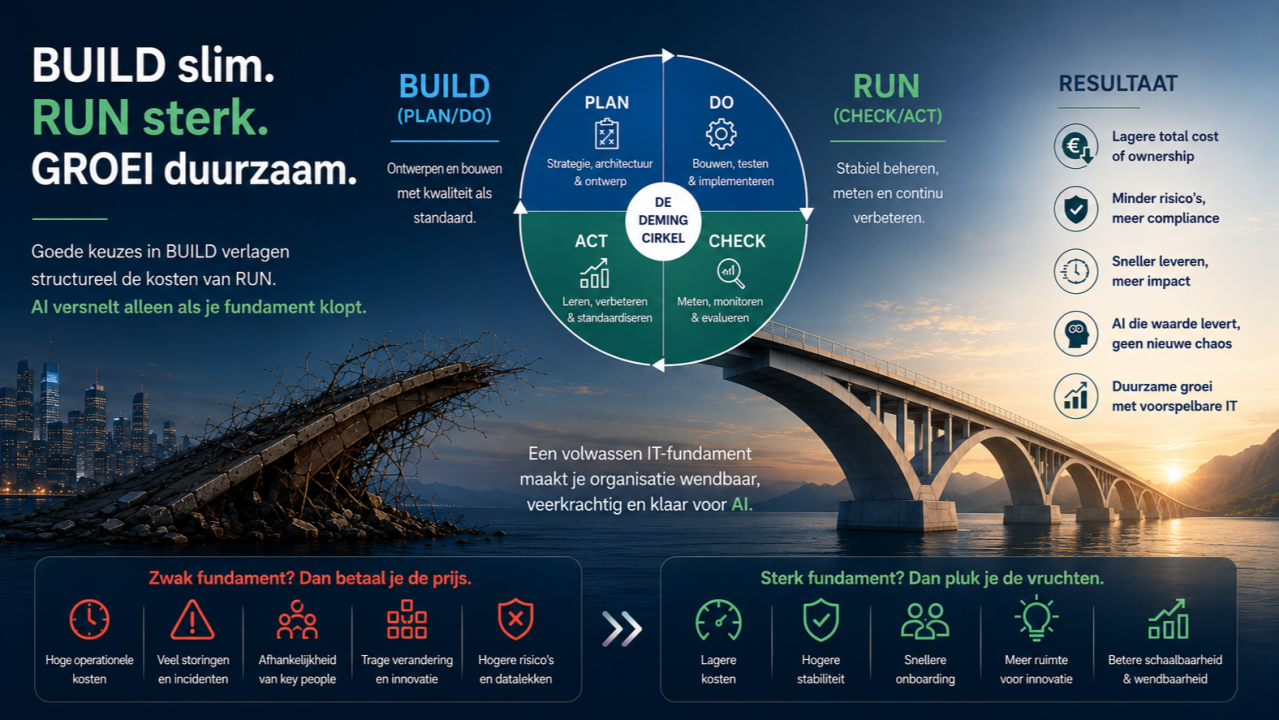
Not a choice between right and wrong. A choice between visible returns today… and structural health tomorrow.
On one side is pressure from the business: “Can we deliver faster?” “Can we use AI?” “Can we have this new innovation live tomorrow?”
On the other is the reality of IT:
- technical debt,
- fragmented processes,
- legacy platforms nobody dares to touch because “it still works, doesn’t it?”,
- manual administration,
- missing standards and dependencies only a handful of people truly understand.
That’s exactly where the tension at the heart of modern IT leadership emerges.
Many organizations enthusiastically invest in BUILD:
New projects. New platforms. New AI solutions.
But forget that RUN ultimately pays the bill.
Every shortcut taken today in architecture, security, governance, or automation comes back like a boomerang later: higher operating costs, greater supplier dependence, lower reliability, and organizational frustration.
Often, you only see it when growth accelerates.
New employees can’t be onboarded quickly. Changes take weeks instead of hours. Incidents keep recurring. Teams are afraid to touch systems in case something breaks. Meanwhile, operating costs rise year after year and organizational progress slows.
Not because people do bad work. Because the foundation was never designed to be scalable and manageable.
Good BUILD sustainably reduces the cost of RUN.
In fact, many modern IT organizations have quietly drifted away from one of the oldest management principles we know: the Deming cycle.
PLAN and DO receive plenty of attention. New initiatives. New technology. New implementations.
But CHECK and ACT often lag behind.
Do we systematically measure whether the platform remains manageable? Do we learn from operational disruptions? Are standards actively improved? Or do we mostly keep adding complexity?
That’s exactly where technical debt emerges.
Not from one wrong decision. From years of BUILDing faster than the organization can sustainably RUN.
A well-designed IT platform:
- requires less manual administration,
- has fewer disruptions,
- onboards employees faster,
- automates repetitive work,
- reduces dependence on specific individuals,
- accelerates integrations and innovation,
- makes compliance simpler, cheaper, and increasingly intrinsic to the platform,
- ultimately creates room for the business to move faster.
That’s where AI becomes interesting.
Not as a “smart layer” on top of chaos. As an accelerator of a well-organized operation.
AI primarily amplifies the quality of your foundations.
If your data is fragmented, ownership is missing, permissions are inconsistent, and processes differ by department, AI mainly accelerates the chaos.
Then you get:
- hallucinated AI answers,
- confidential data in the wrong places,
- poor search results,
- shadow IT and shadow AI,
- employees who trust AI faster than is wise.
But organizations with mature BUILD practices:
- good architecture,
- strong identity governance,
- lifecycle management,
- standardized processes,
- reliable data,
- clear ownership structures,
…can use AI as a multiplier.
There, IT shifts from reactive administration to predictable operations and strategic acceleration.
Perhaps that’s the real boardroom discussion of the coming years.
Not: “How quickly can we introduce AI?”
But: “Is our organization mature enough to extract sustainable value from it?”
Ultimately, the winners aren’t organizations with the most AI tools, but those that use them most intelligently.
The winners are organizations whose RUN has become so efficient, stable, and predictable that BUILD once again has room for truly strategic innovation.
AI doesn’t reward chaos.
AI rewards structure, standardization, and discipline.
That’s precisely why modern IT leadership is increasingly about more than technology… and increasingly about organizational maturity.
Sound familiar? I’m happy to exchange ideas with organizations struggling with scalability, operational complexity, AI adoption, or modernizing their IT operations.
Whether it’s strategic advice, transformation, or temporary support as a fractional CIO/CTO: feel free to send me a message.
Originally published on LinkedIn. View all blog posts.