

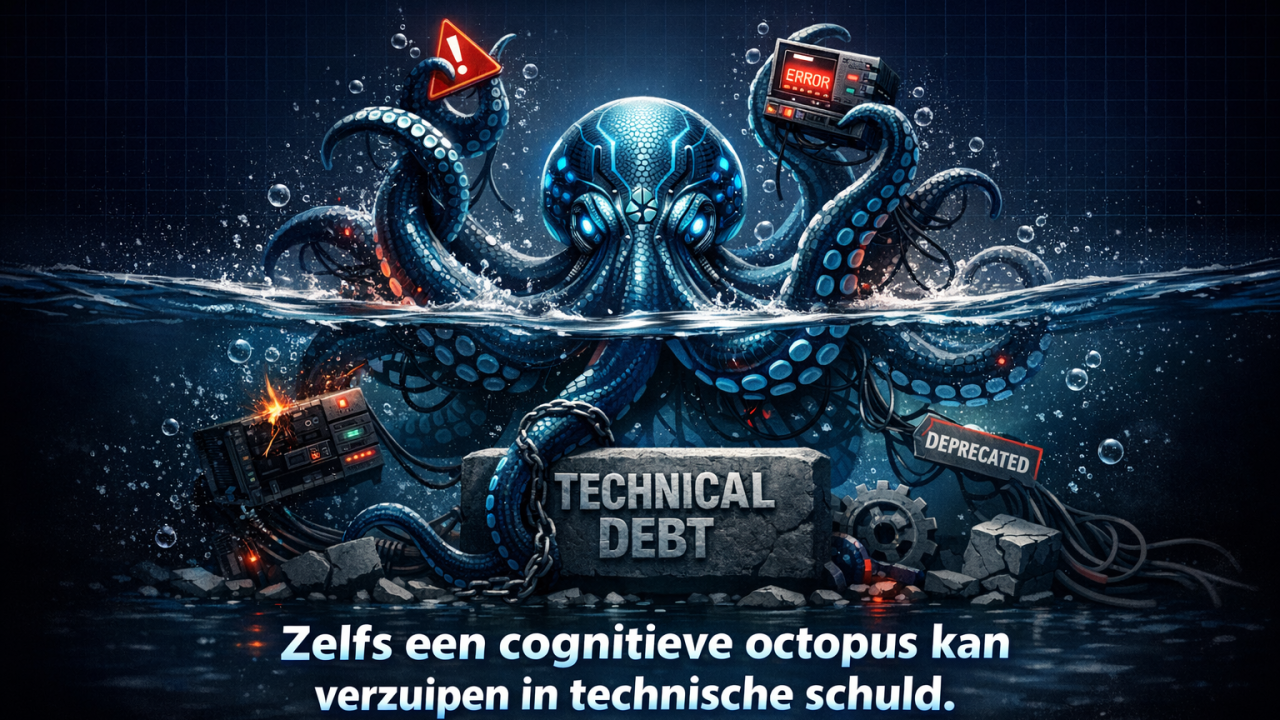
Every organization relies on IT. But few understand exactly what they’re relying on. ING executive Ralph Hamers once said:
“We are not a bank anymore. We are an IT company with a banking license.”
Most people see only the visible 20%: new features, projects, dashboards, releases. The other 80%—the work that ensures stability, security, and continuity—stays invisible. Until something goes wrong.
That’s where a structural problem develops: invisible work doesn’t get a budget. Until it’s too late.
The IT paradox: everything works… until it doesn’t
IT teams constantly do work nobody sees:
- mitigating risks,
- eliminating technical debt,
- preventing security vulnerabilities,
- maintaining integrations,
- streamlining processes,
- keeping systems stable.
This is the work that keeps the organization from stopping. But because it’s invisible, it seems optional.
Until an incident happens.
Then it suddenly becomes visible, urgent, and political. And the same question invariably follows:
“Why didn’t we do this earlier?”
The answer is simple: because it was invisible. And invisible work doesn’t get a budget.
The cognitive octopus: why IT people see everything
IT professionals—especially experienced managers and architects—have a unique ability: they see patterns, dependencies, and risks others don’t see.
They think in chains, not silos. They see the consequences of decisions before those consequences become visible. They feel responsible for the whole, not just their own part.
That’s a superpower. But it’s also a trap.
Because if you solve problems before they become visible, it looks as if there was no problem. So additional budget seems unnecessary.
Ironically, that’s how IT undermines its own business case.
The harsh reality: incidents always cost more than prevention
One sentence captures this perfectly:
“The only thing more expensive than planning for an incident, is the actual incident.”
Incidents don’t just cost money. They cost reputation, customer trust, continuity, focus, and momentum.
Prevention costs money. Incidents cost much more—including recovery, emergency measures, and lost time.
Then comes the second truth, my favorite “7 (or 8?) P’s”:
“Proper prior planning probably prevents piss-poor performance.”
Preparation isn’t overhead. It’s a prerequisite for predictable performance.
Why this does resonate in the boardroom
Executives are held accountable for:
- risk,
- continuity,
- predictability,
- reputation,
- financial stability.
Invisible work affects all those areas. But as long as it stays invisible, it seems optional.
The strategic message that works:
“We don’t have a budget problem. We have a visibility and prioritization problem.”
And:
“We always pay. The only question is: do we pay upfront, or afterward with exorbitant interest?”
A call to organizations
It’s time to recognize invisible work for what it really is:
- risk management,
- business continuity management,
- performance assurance,
- strategic preparation,
- the foundation beneath innovation.
Without that foundation, every digital ambition is built on quicksand.
A call to IT professionals
Don’t just keep solving problems. Make visible which problems you prevent. Translate risks into business impact. Translate technical debt into financial debt. Translate invisible work into strategic value.
Because as long as your work stays invisible, it stays undervalued.
Closing
IT isn’t a cost item; its value is immense: IT lays the infrastructure for the organization’s future.
Invisible work isn’t a luxury. It’s the reason incidents don’t happen.
The only question is: do we invest in preparation, or pay for disruption?
#DigitalTransformation #ITLeadership #TechStrategy #BusinessContinuity #CyberSecurity #RiskManagement #ITGovernance #TechnicalDebt #InvisibleWorkOfIT #CognitiveOctopus #OperationalExcellence #StrategicInvestment
Originally published on LinkedIn. View all blog posts.