

There’s a recurring pattern in organizations that deserves its own diagnostic code:
The Shiny Tool Reflex.
Someone in leadership remembers a tool they used somewhere else, decides it was “pretty good,” and suddenly the entire organization is expected to adopt it — no assessment, no architecture review, no integration plan, no lifecycle thinking.
Just: “Let’s install it.” And then IT gets to deal with the fallout.
The Questions No One Bothered to Ask
Before a tool even touches the environment, there are basic, non‑negotiable questions:
- Does it support SSO
- Can it integrate with anything else
- Does it align with our architecture
- Is it intuitive, or will we need to train people
- Who owns it after installation
- Who maintains it, governs it, and supports it
These aren’t exotic questions. They’re the bare minimum.
Yet installation is treated like the finish line — when in reality, it’s step one of a multi‑year commitment.
The Most Embarrassing Truth: You Probably Already Own Something That Does This
This is the part no one likes to admit:
Most organizations already own a tool that does exactly what the new shiny one promises.
It’s sitting right there in the stack — licensed, paid for, half‑configured, and ignored.
Why?
Because the original implementation was rushed, underfunded, or abandoned halfway. Because no one planned the lifecycle. Because no one followed through.
So instead of fixing what they have, someone buys something new and repeats the cycle.
The Hidden Cost No One Budgets For
Buying a tool is easy. Installing a tool is easy. Announcing a tool is easy. But:
- integrating it
- configuring it
- governing it
- training people
- embedding it in workflows
- maintaining it
- measuring adoption
- deprecating the old stuff
That’s the hard part. That’s the part no one budgets for. That’s the part no one wants to own.
If you want quality, double the time and triple the cost — or double the cost and triple the time. Anything less is wishful thinking.
The Graveyard of Forgotten Tools
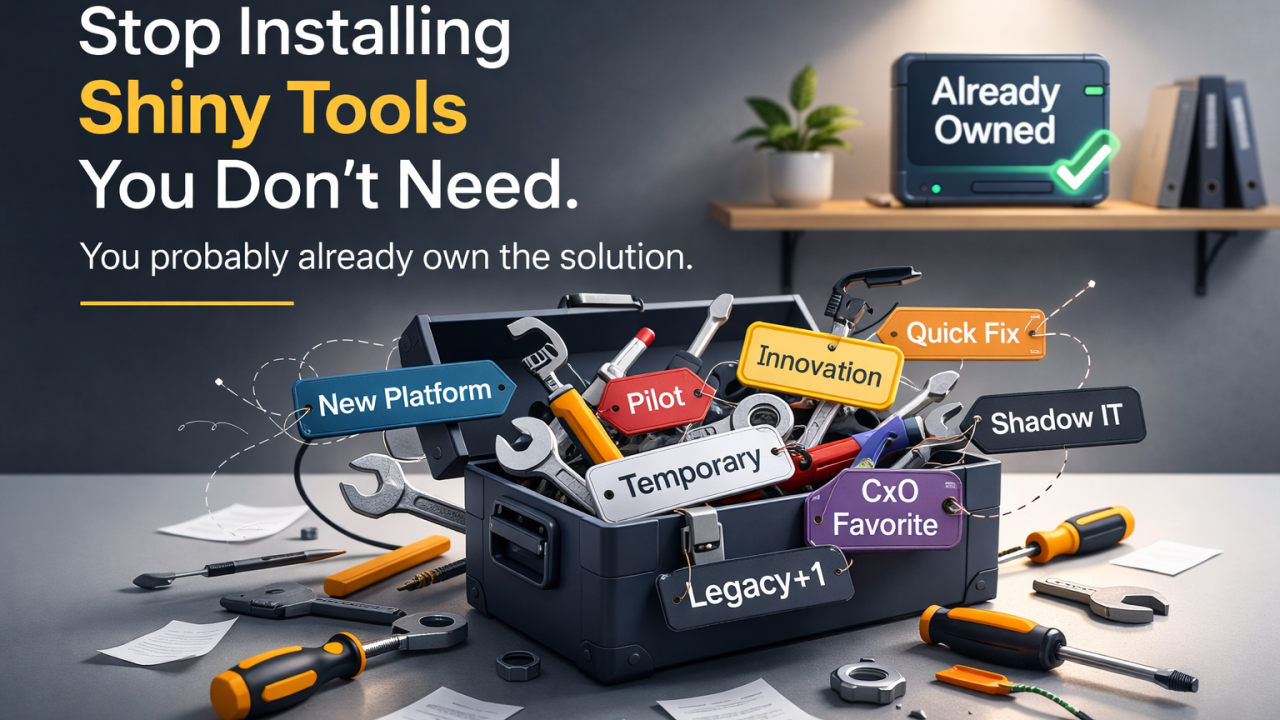
Every organization has one: A dusty toolbox full of:
- tools no one knows exist
- tools no one knows how to use
- tools that overlap with three others
- tools installed “temporarily”
- tools that never got past the login screen
Each one adds friction, risk, and cognitive load.
And each one is a reminder of poor planning.
Remember the 7 (or 8) P’s
Depending on your version:
Proper Prior Planning (and Preparation) Prevents Piss Poor Performance.
Either way, the message is the same:
If you don’t plan, you pay. And you pay in time, money, quality, and credibility.
Stop Sacrificing Quality for Convenience
If you want to introduce a new tool, then own the full lifecycle:
- Evaluate it properly
- Integrate it properly
- Document it properly
- Train people properly
- Maintain it properly
Otherwise, don’t install it. Don’t propose it. Don’t add another half‑baked, unsupported, unintegrated, unloved tool to the pile.
Your people — and your budget — will thank you.
Originally published on LinkedIn. View all blog posts.