

Over the past few years, I’ve watched a fascinating development.
More and more organizations use AI for customer contact, service desks, HR processes, and internal support. That isn’t surprising. AI keeps improving, is available around the clock, never gets tired, and can process enormous amounts of information. From an efficiency perspective, it’s often a logical step.
Yet increasingly, I feel uneasy.
Not because AI is bad. Quite the opposite. But because I wonder whether we’re slowly losing something much harder to measure than response times, cost savings, or chatbot resolutions.
The ability to see problems that are never reported.
The aircraft that never came back
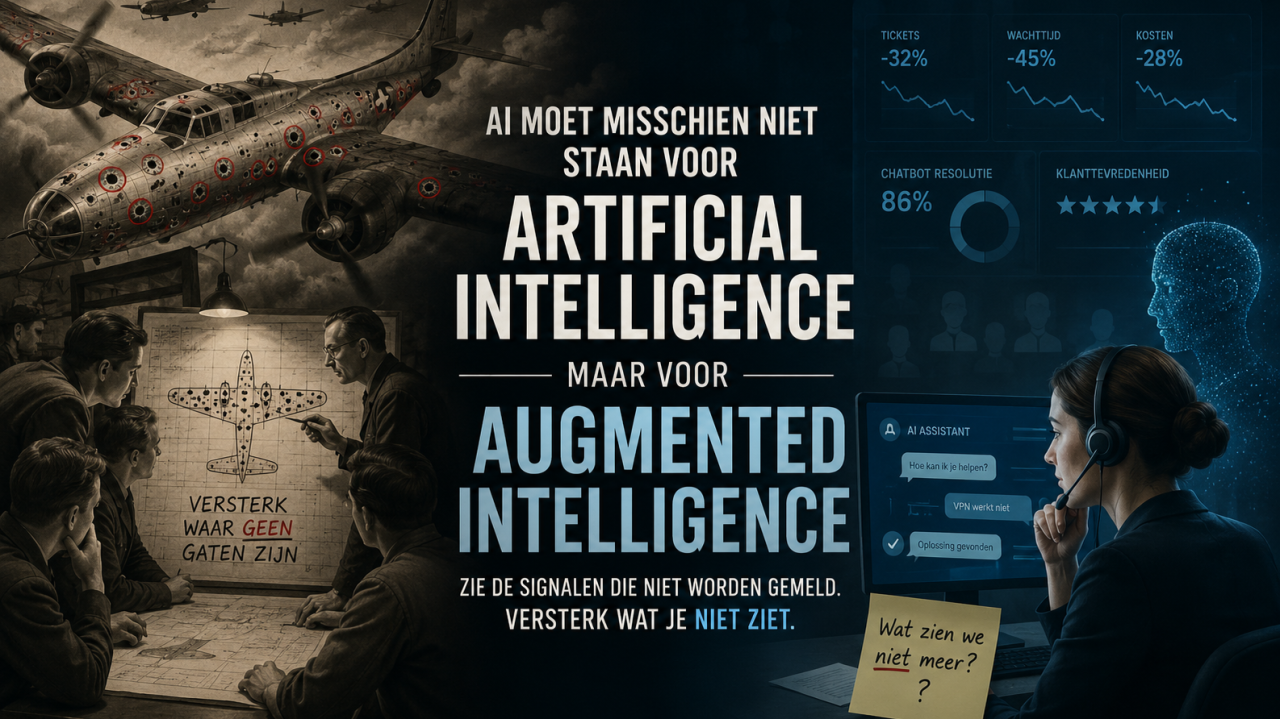
During World War II, the Allies faced a practical problem. Bombers returned from missions with bullet holes in their wings, fuselages, and tail sections. Engineers did what any rational organization would do: they collected data, analyzed patterns, and looked for improvements.
The conclusion seemed logical.
“Reinforce the areas with the most bullet holes.”
Until statistician Abraham Wald asked a fundamentally different question:
“Why didn’t the other aircraft come back?”
That one insight changed everything.
The aircraft being studied were exclusively the survivors. The visible bullet holes were in places where an aircraft could apparently be hit and still return safely. The truly critical components were precisely the areas with hardly any visible bullet holes. Not because they were never hit, but because aircraft hit there simply never made it home.
The solution turned out to be the exact opposite of what the available data seemed to suggest.
Don’t reinforce where the most damage is visible. Reinforce where damage is absent.
Because the missing data told the real story.
Today, we call this principle survivorship bias. The longer I watch the current AI hype, the more often I think many organizations are making exactly the same mistake.
Everything is green
Modern organizations are better at measuring than ever. We have dashboards, KPIs, Power BI reports, AI analyses, customer satisfaction scores, and operational metrics. Almost everything seems capable of being made visible.
Many management reports feature the same indicators:
- Fewer tickets
- Shorter waiting times
- Higher self-service adoption
- More chatbot handling
- Lower operating costs
- Higher productivity
On paper, it looks fantastic.
But does a decline in reports automatically mean there are fewer problems?
Or does it mean people have stopped reporting them?
That distinction matters far more than many organizations realize.
The KPI trap
Perhaps there’s a deeper problem here. Many organizations primarily measure activity and efficiency, but much less often the actual outcome. In modern management language, we could say we often manage by KPIs while forgetting to check whether we’re actually getting closer to our OKRs.
You see it everywhere. We measure how many tickets a service desk handles, how quickly calls are answered, how long customers wait, and how many interactions a chatbot can handle independently. Those aren’t bad indicators in themselves. They tell us something about process efficiency.
But do they tell us anything about the value delivered?
Take a service desk. Is the goal to handle as many tickets as possible? Or to actually solve problems? That sounds like a semantic distinction, but it’s fundamental.
Closing a ticket doesn’t automatically mean a problem is solved. A chatbot ending a conversation doesn’t automatically mean a customer has been helped. And an employee who stops calling hasn’t necessarily seen their problem disappear.
Sometimes the prettiest dashboards are actually a sign that people have given up.
Perhaps we should spend less time asking:
“How many tickets did we process?”
And more time asking:
“How many problems did we actually solve?”
Followed by an even more important question:
“What do our employees and customers think about that?”
Because when a service desk mainly becomes a firewall between users and the organization, a dangerous situation develops. You’re filtering out not just questions, but signals. Those signals are often the earliest indicators of future problems.
You see the same pattern in the boardroom. The discussion often centers on efficiency, cost reduction, and operational optimization. But how much lower do operating costs actually need to go? Is reducing costs the goal itself, or is the goal to build a better organization?
Those sound like similar strategies, but in practice they often produce completely different outcomes.
The most successful organizations I’ve seen throughout my career were rarely obsessed with costs alone. They were obsessed with value. For customers. For employees. For shareholders. For the long term.
Costs were usually a consequence of good decisions, not the primary objective of those decisions.
“The most sustainable form of cost savings is often investing in quality.”
The problems that are never recorded
Every organization contains enormous amounts of hidden work and hidden frustration. Problems employees experience daily that never enter a system.
Not because those problems don’t exist, but because people are human.
Many are rushed because the almost permanent “do more with less” mentality has become standard in so many organizations. Others think reporting won’t help anyway. Some don’t want to be known as the person who complains about everything. And often, people have simply devised a workaround to get their work done.
Every experienced IT manager, service desk manager, or customer service professional recognizes this.
A user reports:
“My VPN isn’t working.”
But an experienced service desk employee often hears much more than that sentence:
- Maybe this is the fourth report from the same department this week.
- Maybe the problem has existed for months.
- Maybe someone has devised an unsafe workaround.
- Maybe there’s frustration nobody records.
- Maybe the VPN problem isn’t the problem at all, but a symptom of something much bigger.
That context usually isn’t in the ticket.
You hear it between the lines. In someone’s tone. In an employee’s hesitation. In a customer’s frustration. In the questions that aren’t really being asked.
What happens when AI becomes the front door?
Let me be clear: I’m absolutely not against AI.
In fact, I think AI will have an enormous positive impact on almost every organization in the coming years. It can automate repetitive tasks, make knowledge more accessible, and help employees find answers faster. In many areas, AI will make organizations faster, more consistent, and more efficient.
But I see a risk when organizations primarily approach AI as a cost-cutting measure.
When the underlying question becomes:
“How can we eliminate as much human contact as possible or phase out employees in favor of AI?”
an interesting paradox emerges.
AI is excellent at processing signals it receives. It can recognize patterns, classify information, and analyze enormous amounts of data. But how do you detect signals that are never sent?
How do you measure the customer who leaves without complaining? How do you record the employee who spends ten extra minutes working every day because a process doesn’t work properly? How do you discover frustration that is never voiced? How do you see security risks caused by employees devising solutions outside official processes?
Those are often the most valuable signals. And they’re the first to disappear when human interaction is completely replaced by automation.
But there’s a second risk beneath the surface.
Almost all AI systems learn from historical data. In other words: AI learns from what was previously observed, recorded, and stored. That’s both the strength and the limitation of almost every AI solution.
- How do you learn from problems never reported?
- How do you train a model on frustrations never expressed?
- How do you recognize a risk that has never appeared in your datasets?
AI is extraordinarily powerful at recognizing existing patterns. But patterns from the past aren’t automatically signals of the future. In fact, the biggest changes often begin as deviations from existing patterns.
An experienced employee saying:
“I don’t know exactly what’s going on, but this feels different.”
sometimes produces more valuable information than a thousand historical tickets.
Experienced employees process more than words. People often intuitively sense when something isn’t right, when frustration runs deeper than what’s said, or when a problem is only a symptom of something deeper. AI is getting better at recognizing and classifying those signals, but it doesn’t experience them. That difference may seem subtle, but it can separate solving an incident from understanding an underlying problem.
Where AI primarily looks at what happened before, people have a unique ability to notice something new emerging. That’s where innovation begins—but also incidents, crises, and risks.
Artificial Intelligence or Augmented Intelligence?
Perhaps that’s the biggest mistake in our thinking right now. We often discuss AI as if it could ultimately replace human observation. As if technology could not only analyze faster than people, but eventually understand what’s happening inside organizations better than they do.
I think we’d be better off looking at AI differently:
Not as Artificial Intelligence, but as Augmented Intelligence.
Technology that strengthens people instead of replacing them.
That doesn’t mean using less AI. Quite the opposite. Let AI handle simple questions, recognize patterns, search large volumes of information, and automate routine work. In those areas, AI is often faster, more consistent, and more scalable than people will ever be.
The mistake comes when organizations use the freed-up time to cut human contact or availability even further. That’s the missed opportunity. When AI reduces operational pressure, it creates room for something much more valuable: real conversations, observation, curiosity, and understanding what’s happening beneath the surface.
Organizations aren’t made of datasets, dashboards, and KPIs. They’re made of people. And people don’t always say what’s really happening. Frustrations are swallowed, workarounds become normal, and risks often only become visible when someone takes time to look beyond the recorded incident.
The danger of perfect dashboards
Perhaps that’s the greatest paradox of the AI age. As organizations collect more data, they risk moving further away from reality.
Not because the data is wrong. Quite the opposite. The figures can be completely correct. The dashboards can work perfectly. Reports can show faster ticket handling, falling costs, and rising productivity.
But as with the World War II aircraft, visible data tells only part of the story.
The bullet holes were real. The analyses were correct. The conclusions seemed logical. Yet initially, they pointed to exactly the wrong solution because nobody looked at the aircraft that hadn’t returned.
The same risk exists in organizations today. We analyze submitted tickets, conversations that take place, and recorded feedback. But how often do we consider the signals that no longer arrive? The employee who has given up reporting problems? The customer who quietly leaves? The risks emerging outside the processes we measure?
Perhaps that’s the most important question executives, CIOs, IT managers, and service organizations should ask themselves in the AI age:
“Are we only looking at the signals we receive, or also trying to understand which signals we no longer receive?”
Sometimes the greatest risk isn’t what you see, but what you no longer hear.
Perhaps that’s ultimately the most important lesson of all. AI excels at recognizing known patterns. Leadership is about recognizing unknown ones.
#ArtificialIntelligence #AugmentedIntelligence #Leadership #ITLeadership #CustomerExperience #DigitalTransformation #ServiceManagement #Management
Originally published on LinkedIn. View all blog posts.